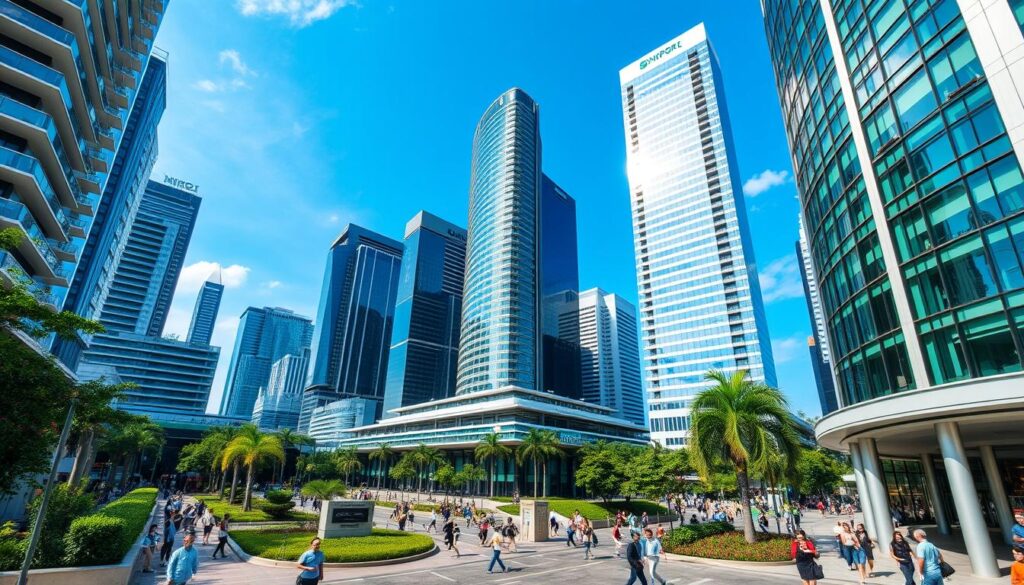
Singapore’s commercial real estate is seeing exciting changes in the first quarter of 2024. The office sector is bouncing back with more deals. The retail market is also improving, thanks to more tourists.
The industrial market is strong, with steady rent and price increases. There’s a big push for green and sustainable buildings.
Things are looking up for commercial property in Singapore. Interest rates are falling, and the S&P 500 is rising. This makes investors more confident in the market.
Key Takeaways
- Prime office rents in Singapore rose by 5.1% year-on-year, with a declining vacancy rate of 10% in 2023.
- The retail sector is projecting 3-5% growth due to tourism recovery, adapting with experiential strategies and a 5% year-on-year increase in prime retail rents.
- The industrial market shows resilience with a 2% rental rate increase for prime warehouses and a focus on sustainable development.
- E-commerce has impacted retail sales by 2%, driving digital integration in shopping experiences.
- Flexible workspaces have gained popularity post-pandemic, affecting office demand and encouraging hybrid models.
Overview of Singapore’s Commercial Property Market

Singapore’s commercial property market is always changing. It includes Office Buildings, Retail Spaces, and Industrial Properties. The office sector is recovering, with more deals happening. But, it’s facing challenges from too much new supply, which might affect occupancy rates and rents.
The retail sector in Singapore is coming back strong. Vacancies are going down, and leasing is up. This is thanks to strong spending and a love for shopping in person. Sales dropped by 2% by October 2023, but food and alcohol sales jumped by 12.2%. This shows a change in what people want to buy.
The Industrial Properties market in Singapore is holding its ground. Rentals and prices are still going up, even with new supply coming. It’s important to watch demand closely to keep things stable. Since late 2020, rents and prices have risen, mainly because of the lack of quality assets.
Singapore is a top choice for investors, along with Japan, South Korea, and Australia. It attracts investors looking for long-term gains, especially in hospitality, co-living, and logistics.
Economic Growth and Property Values
Singapore’s economy grew by 0.7% in Q3 2023 compared to the year before. The production sector dropped by 5% but showed a 0.2% growth recently. Global economic issues, government policies, and sector trends affect these numbers.
The link between GDP growth and real estate is clear. When the economy grows, businesses need more space. This leads to higher occupancy rates and rental income. But, during downturns, companies might downsize, causing vacancies and lower rents.
Interest rates are key in the commercial real estate market. Higher rates make financing more expensive, lowering property values. Low rates, however, make properties more valuable as financing becomes easier, boosting new developments and purchases.
Inflation affects commercial property values and rents too. High inflation lets landlords raise rents but can hurt businesses. High inflation often means higher interest rates, making borrowing more expensive and slowing the market.
Impact of Inflation on Commercial Property
The economy in Singapore is facing high Inflation Rates. This is affecting the commercial real estate sector. Costs for construction, insurance, and running properties are going up. This is making it harder to keep rental income and property values stable.
Recent data shows U.S. office property values dropped by about 4% in June 2022. Transaction volume for buildings over $25 million fell from $8 billion to $3 billion year-over-year. Industrial property values went down by 6%, but they are still 18% higher than a year ago.
Inflation’s effects are especially seen in apartments and retail. Apartment values fell by 4% last month but are still up 15% annually. Retail strip centers, however, have seen a big increase in transaction volume above $25 million. This shows a change in how investors view these properties.
Despite these issues, commercial real estate has often done better than inflation. Over the last 25 years, it has outperformed inflation 87% of the time. But the ongoing inflation might lead to more careful investment choices. It could also influence decisions on property development and upkeep in the coming months.
Government Policies Affecting Real Estate
The Singapore government has been key in shaping the commercial real estate scene. Since the 1990s, it has focused on spreading economic activities beyond the central business district (CBD). The Urban Redevelopment Authority (URA) leads this effort, using schemes like the CBD Incentive Scheme and projects like the Greater Southern Waterfront.
The government’s influence goes beyond planning cities. It’s also boosting public housing and selling more land for private homes. This affects the commercial leasing market. Government policies can change real estate values, from taxes to environmental rules.
At the state and local levels, policies on property taxes, rent control, and affordable housing are important. Local governments control zoning and land use, which affects where and how development happens. This, in turn, impacts property values.
As Singapore’s real estate market grows, government policies will keep playing a big role. They balance the needs of businesses, residents, and the economy.
Foreign Investment in Singapore’s Commercial Real Estate
Singapore’s stability and strong economy draw many foreign investors. These are mostly individuals, not big companies. They look for long-term gains, focusing on specific types of commercial properties.
They prefer to invest in assets like strata offices and shophouses. This cautious approach helps them avoid quick losses. Instead, they aim for steady growth over time.
Japan, South Korea, and Australia also see Singapore as a prime investment spot. They’re drawn to the hospitality, co-living, and logistics sectors. This is because of Singapore’s strong economy and business-friendly environment.
In Singapore, the commercial property market has a lot to offer. Freehold properties, for example, can yield around 5% in rental income. But, they also come with higher maintenance costs.
Commercial properties face a 10% property tax rate. There’s also a Buyer’s Stamp Duty based on the purchase price. These factors are important to consider when investing.
Despite these challenges, Singapore’s commercial real estate remains attractive to investors. The country’s economic stability, favorable laws, and diverse investment options make it appealing. Investors carefully weigh the financial and regulatory aspects to benefit from Singapore’s growth potential.
The Role of Technology in Commercial Real Estate
The commercial real estate industry is changing fast. It needs to work better, analyze data better, and make things easier. New PropTech solutions are key to staying ahead and pleasing clients.
Many firms still use old systems, but PropTech is growing fast. It’s expected to grow 15.8% yearly until 2030. This growth is because of the need to keep up with new trends, like working from home.
Technology does more than just make things work better. It also helps in marketing properties. It makes creating content, listing properties, and analyzing data easier. This helps businesses make smart choices.
New tech like AI, IoT, and VR is changing the game. They make managing buildings better, help with development, and give buyers and tenants cool experiences. Keeping up with these techs is crucial for property values.
But, there are challenges like keeping data safe. Yet, the good things about tech, like being more efficient and sustainable, are worth it. As the industry keeps using PropTech, it will be ready for whatever comes next.
Assessing the Demand for Commercial Spaces
In Singapore’s thriving commercial real estate market, the demand for Office Space Demand and Retail Space Usage remains strong. The city’s economic growth and resilience have fueled a steady recovery. The office sector is leading the charge.
Office buildings have seen a resurgence in activity since early 2020. Businesses are adapting to the changing work landscape. Meanwhile, prime retail spaces along Orchard Road are bustling with energy.
Restaurants and shops welcome back consumers with cautious optimism. The Retail Space Usage in these prime locations continues to show the market’s resilience. Rents are expected to outpace other submarkets.
Orchard Road’s prominence as a premier shopping destination is highlighted by its recent ranking. It’s the 12th most expensive retail destination globally. Shifts in consumer behavior, such as increased tourism and a focus on food and alcohol sales, have contributed to the area’s comeback.
Analyzing key market indicators, such as vacancy rates, absorption rates, and rental trends, provides valuable insights. By understanding the economic factors, demographic trends, and regulatory environment, investors and developers can make informed decisions. They can capitalize on the growing opportunities in the Office Space Demand and Retail Space Usage sectors.
Sustainability and Green Buildings
Companies in Singapore are under pressure to be more sustainable and ethical. They need to meet Environmental, Social, and Governance (ESG) regulations. But, many lack the data and procedures to do so.
This lack is a big challenge, but it also opens doors for new ideas in green real estate.
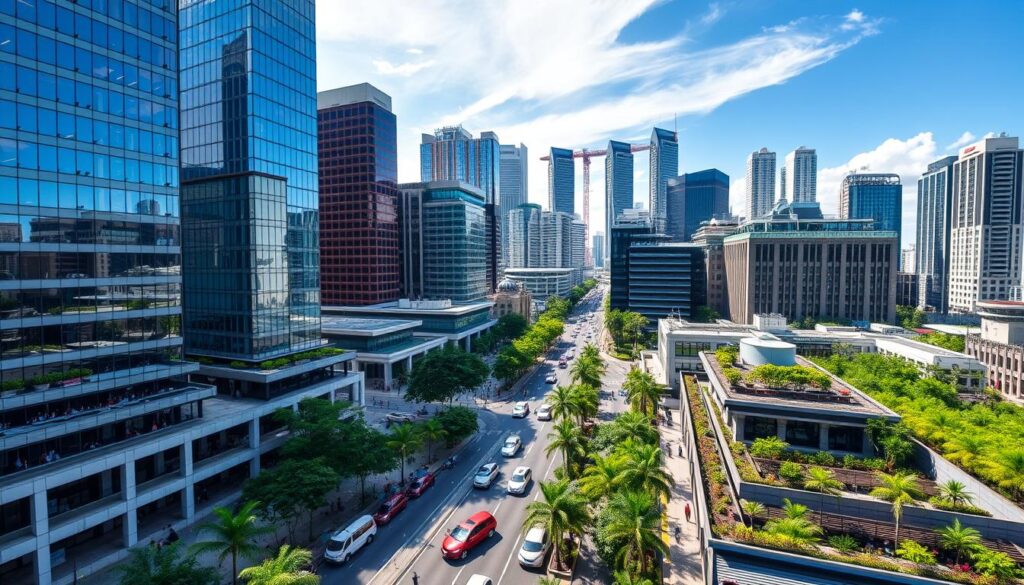
In Singapore, commercial real estate is a big part of the environmental problem. It’s responsible for over 20% of the country’s emissions. The government has set big goals to change this through the Singapore Green Plan 2030.
The plan aims to cut waste, boost solar energy, and grow cycling paths. It also wants to make 80% of buildings green by 2030. This will make these buildings 80% more energy-efficient than they were in 2005.
New technologies and designs are making commercial buildings more sustainable. Tools like CIM’s PEAK help buildings use less energy and cut emissions. Buildings like Simmons & Simmons and offices by Gartner and Nutanix are leading the way with green designs.
As more people want green buildings, companies focusing on sustainability will attract the best tenants. The commercial real estate in Singapore is changing fast. It’s moving towards being more sustainable and meeting ESG standards.
The Effects of COVID-19 on the Commercial Property Market
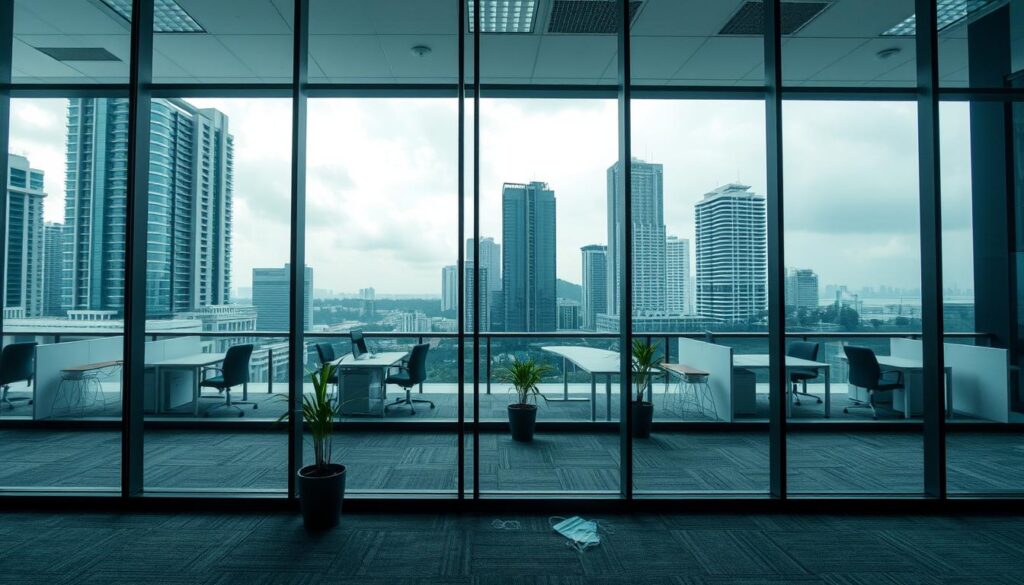
The COVID-19 pandemic has greatly affected the commercial property market in Singapore. In the Raffles Place/Marina Bay area, occupancy rates were at 96.0%. The CBD saw rates at 94.4%, showing strong demand despite the pandemic’s hurdles.
Many businesses chose to renew their leases in prime spots for cost savings. The pandemic pushed for flexible work and more focus on health and safety in offices. Yet, the outlook is not all positive – office vacancy rates are forecasted to hit 18% by 2030, a 55% jump from 2019.
The pandemic’s impact has been wide-ranging. Rent prices in cities like New York and San Francisco dropped by 18% and 28% from 2019 to 2022. Office building sale prices have also seen big swings, with New York City’s transaction volume falling 36% and Atlanta’s dollar value rising 31%.
Despite these hurdles, the commercial property sector in Singapore is showing resilience. The economic recovery looks promising, and landlords are diversifying their portfolios. Yet, the long-term effects of COVID-19 on this market are still uncertain.
Future Predictions for Singapore’s Commercial Property
Singapore’s commercial property market is set for growth in the next few quarters. Prime office rents are likely to stay the same because of limited supply. Retail rents in top spots could rise by 3-5% in 2023 as tourism and MICE sectors bounce back.
The industrial sector expects a big increase in supply in 2024. This might slow down rent and price hikes. In 2023, logistics saw an 8.4% rental jump, a bit less than 2022’s 9.2%. But, with little new space coming in 2024, a shortage is forecast until 2025.
New trends in Singapore’s commercial property market include more focus on sustainability and tech. The residential leasing market is also expected to favor tenants in H2 2023. Rents are likely to grow by only 13% in 2024, down from 29.7% in 2022.
Despite global economic worries, Singapore’s property market is expected to stay strong. This is thanks to solid fundamentals, political stability, and its role as a financial hub. The government’s policies will be key in shaping the market, aiming for stability, sustainable growth, and affordable homes.
Comparative Analysis with Regional Markets
Singapore’s commercial real estate market is a top choice for investors. It’s alongside Japan, South Korea, and Australia. The appeal lies in the hospitality, co-living, and logistics sectors. These areas benefit from Singapore’s economic stability and resilience.
Compared to Hong Kong, Singapore’s market is more stable and growing. This is especially true for offices and retail. Non-institutional investors see long-term value in Singapore.
Looking at data, vacancy rates, construction costs, lending rates, and employment affect office rents in Singapore. This approach is common in Europe and the United States. But, it’s less seen in Southeast Asia.
The ups and downs in the commercial property market come from various factors. This highlights the need to understand the Regional Markets and Investment Trends well.
Navigating Challenges in the Commercial Property Sector
The commercial property sector in Singapore has many challenges. It must deal with economic cycles and changing market demands. Knowing the local economy and its effect on property values is key.
Looking at demographic trends helps understand demand. For example, population growth and income levels show what types of properties are needed.
Being flexible and innovative is crucial. Turning old office buildings into homes is one way to meet housing needs. Keeping tenants happy with good amenities and flexible leases is also important.
Using new technologies, like smart buildings, can give you an edge. Working together in the industry helps solve problems and find new chances. It’s important to network, keep good lender relationships, and stay up-to-date on laws and rules.
